We often see property owners surprised by how quickly a sudden rainstorm turns a backyard into an unusable swamp. You know how frustrating it is to watch water pool exactly where you planned to relax. The culprit is usually the very ground beneath your feet.
Our team has spent years learning How to Manage Red Clay Drainage Before Building a Patio in Charlotte. The primary soil in our region is the Cecil soil series, which is a dense kaolinite clay. This thick red layer sits just four to eight inches below the topsoil.
It acts exactly like a giant, non-porous bowl.
Charlotte receives an average of 43 inches of rainfall annually. That massive volume of water has nowhere to go when it hits our local clay. It simply sits on the surface, ruining hardscapes and threatening foundations.
We are going to break down why this specific soil causes so much trouble. Then, we will share the exact gravel bases, grading techniques, and drain systems that actually work in this environment.
Why Red Clay Creates Drainage Problems
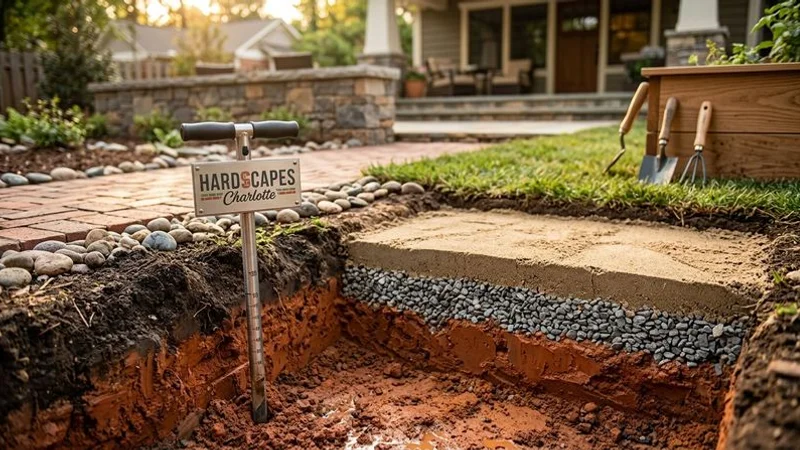
Our experience shows that the drainage challenge of red clay comes down to microscopic particle size. Clay particles pack together so tightly that they create a dense matrix with almost zero empty space. The percolation rate of Charlotte’s red clay is measured in tiny fractions of an inch per hour.
Water simply cannot pass through it effectively.
We know that surface water encountering this tight clay spreads laterally to find the path of least resistance. On a sloped lot, gravity pulls the runoff right to the lowest point. A flat yard forces the moisture to stand until evaporation slowly dries it out.
The Shrink-Swell Cycle of Cecil Soil
Our local Cecil soil expands significantly when it absorbs moisture and contracts as it dries. This repeated shrink-swell cycle happens continuously through the wet and dry seasonal patterns. The ground heaves and settles unevenly beneath anything built on top of it.
You will see the results of this expansion very clearly in several ways:
- Cracked mortar joints: Rigid connections break under uneven pressure.
- Displaced pavers: Individual stones tilt, creating dangerous trip hazards.
- Tilted retaining walls: The lateral pressure of wet clay pushes blocks outward.
- Sunken walkways: Heavy foot traffic compacts wet areas unevenly.
We have measured this expansion factor directly on local job sites. Charlotte’s red clay can expand by five to ten percent when saturated. A standard twenty-foot patio can experience over an inch of potential movement if not properly protected.
The Consequences of Ignoring Drainage
Our repair teams regularly fix hardscapes that were built without adequate preparation. The cost of skipping a proper sub-base is never just hypothetical. A poorly planned project will fail quickly in this specific geographic region.
Standing Water on the Patio Surface
We often see the most visible consequence right after a heavy rainstorm. Water pools heavily when a surface sits on improperly graded clay. The base traps the moisture, leaving it to stand for days at a time.
This standing water causes multiple secondary issues:
- It stains expensive paver surfaces with hard mineral deposits.
- It promotes slippery moss and green algae growth.
- It creates a breeding ground for Asian tiger mosquitoes during the humid summer months.
- It ruins your ability to actually use and enjoy the outdoor space.
Our clients express immense frustration when their new entertainment area is flooded. You want to use your backyard precisely when the weather cools down after a storm.
Paver Settlement and Heaving
We always warn property owners about building directly on bare dirt. A patio base constructed on red clay without an adequate gravel sub-base will move constantly. Individual stones rise or sink as the ground beneath them shifts through the seasons.
The settling usually appears within the first two years of installation. A full seasonal cycle from a wet winter to a dry summer triggers the initial movement. The damage accelerates quickly once the first gaps and low spots develop.
Our inspections reveal that these low spots collect even more water. The extra moisture further saturates the clay beneath the blocks. This vicious cycle destroys the entire surface level over time.
Foundation and Structural Damage
We understand that water failing to drain away from your home does not just disappear. It migrates to the path of least resistance, which is frequently the foundation of your house. Improperly drained hardscaping channels runoff directly into a vulnerable perimeter.
The connection between hardscape planning and foundation health is critical in the US, especially in the Carolinas. Many local homes sit on relatively shallow footings surrounded by dense earth. Poor drainage directly contributes to basement moisture intrusion, crawl space flooding, and severe settlement. Companies like Dry Pro Systems in Charlotte frequently cite poor exterior drainage as the leading cause of expensive crawl space encapsulations.
Our goal is always to improve the grading around your home. Every new walkway or retaining wall should actively push water away from the structure.
Solutions: How to Manage Red Clay Drainage Before Building a Patio in Charlotte
Our approach to effective water management involves multiple strategies working together. You need a comprehensive system to move water safely away from the installation and your home.
Grading and Slope
We always grade residential projects to fall away from the house. A minimum slope of one-quarter inch per foot, or approximately two percent, is the industry standard. This gentle angle is virtually invisible to the eye but highly effective at directing surface runoff.
The proper grading must extend far beyond the stones itself. The surrounding landscape has to accept and channel the water flowing off the hardscape. The City of Charlotte’s Post-Construction Stormwater ordinances actually require that runoff be managed responsibly without flooding neighboring properties.
Our designers look for a continuous downhill path across the property. They direct the flow to appropriate discharge points like a rain garden or a natural swale.
Compacted Gravel Base
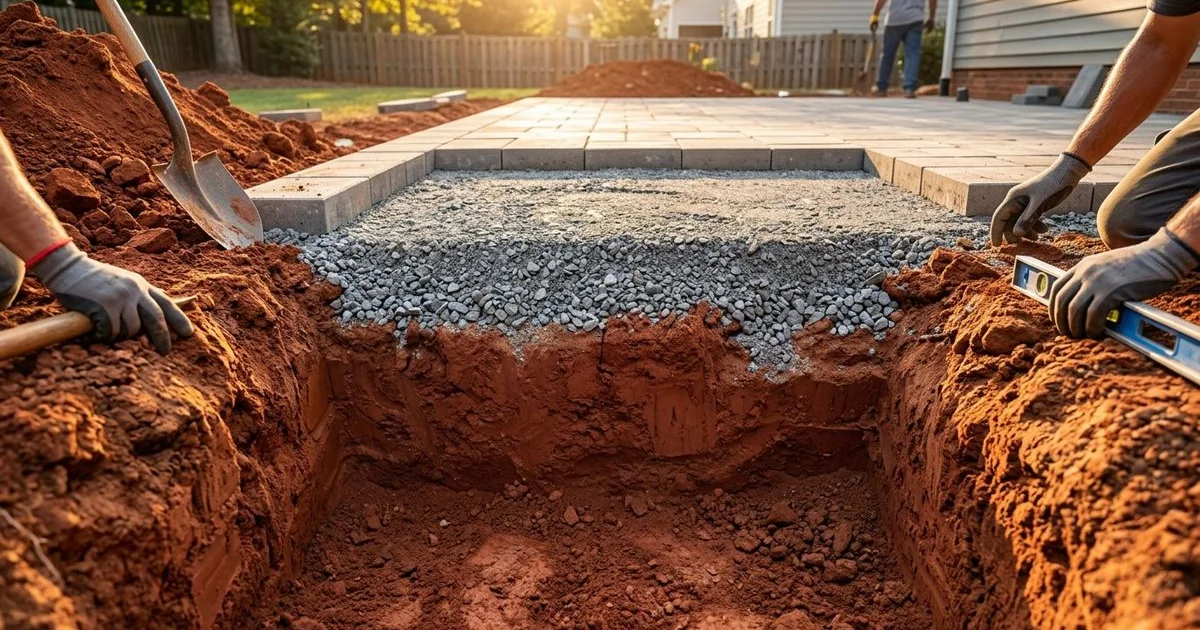
We rely on a deep gravel base to serve two critical functions. The stone provides a stable foundation that completely ignores seasonal moisture changes. The rock also creates a porous layer that allows water to flow laterally beneath the surface.
Our crews recommend a minimum six-inch compacted gravel base for standard residential spaces. They increase that depth to eight or ten inches for areas supporting heavy loads like outdoor kitchens. Number 57 stone is the preferred material for these applications in the Piedmont region.
This specific aggregate is an angular crushed stone rather than a rounded river rock. The sharp edges interlock tightly when compacted. This interlocking action forms a completely stable foundation that still lets moisture pass through, especially when we extend the gravel base several inches past the edges of the pavement.
French Drains
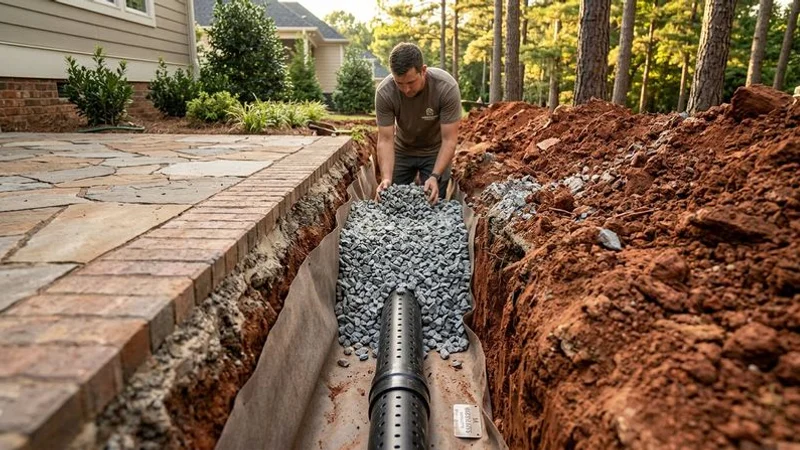
We frequently install French drains to handle heavy subsurface flows. This system consists of a perforated pipe surrounded by gravel, laid in a trench alongside the edge. Water migrating through the base enters the pipe and flows safely away from the home.
The installation requires precise measurements to function properly. We pitch French drains at a minimum slope of one percent, which equals about one inch of fall for every eight feet of run. The standard setup uses four-inch diameter corrugated or rigid PVC pipe.
You must follow specific rules to ensure the discharge point functions correctly:
- Wrap the entire trench in a high-quality non-woven filter fabric to stop clay particles.
- Connect to an existing municipal stormwater system if permitted.
- Use a daylight outlet at the property edge.
- Disperse the flow into a dedicated rain garden.
Channel Drains
We use channel drains when a surface meets a house wall or a door threshold. A channel drain is a narrow, grated trench set flush with the concrete to intercept fast-moving sheets of water. This fixture catches the runoff before it can breach the foundation or enter the home.
The hardware choices make a massive difference in performance. We often specify systems like the NDS Slim Channel kit for residential outdoor living spaces. This two-inch wide extruded PVC drain features slotted grates that whisk away up to 21 gallons of water per minute.
Our installers secure these fixtures carefully during construction. The channel requires at least four inches of concrete encasement on the sides and bottom for proper support. Workers recess the grate about one-eighth of an inch below the final grade if the area will see heavy wheeled traffic.
Dry Creek Beds
We love using dry creek beds because they solve functional problems while looking beautiful. A dry creek bed provides a dedicated channel that conveys stormwater across the property during heavy rains. The feature mimics a natural watercourse using varied sizes of decorative river rock.
The aesthetic appeal remains strong even during dry weather. You can border the rock channel with drought-tolerant native plantings to soften the edges.
Our landscape architects frequently use dry creek beds as the final discharge point for French drains. They serve as a perfect transition element between structured entertainment areas and the natural, wooded sections of a typical local yard.
The Cost of Proper Drainage
Our transparent pricing models always include the necessary site preparation. Proper drainage infrastructure adds to the upfront cost of any project. A thick compacted gravel base, professional French drains, and precise grading require significant labor and materials.
We estimate that proper preparation adds fifteen to twenty-five percent to the base price of the installation. A typical local paver project might require an additional $2,000 to $5,000 in subsurface infrastructure.
| Drainage Feature | Function | Average 2026 Added Cost |
|---|---|---|
| Compacted #57 Gravel Base | Prevents settling and provides sub-surface flow | 10% - 15% of project base |
| French Drain System | Channels heavy subsurface water away | $60 - $90 per linear foot |
| NDS Slim Channel Drain | Intercepts surface water near home foundations | $100 - $150 per linear foot |
This initial investment is absolutely non-negotiable when building on our regional soils.
Our repair estimators constantly quote jobs where the original contractor skipped these crucial steps. The cost of remedying a failing layout is brutal. You have to pay to remove the old stones, re-grade the site, install the missing pipes, and then rebuild the entire surface from scratch.
A full replacement usually costs three to five times more than doing it correctly the first time.
We hear from countless homeowners who deeply regret choosing the lowest initial bid. The pavers, the stone, and the furnishings get all the visual attention. The invisible work beneath the ground actually determines if your space will last for decades or fail in two years.
Work with Drainage Experts
Our local geography is a reality that every outdoor project must respect. The difference between a surface that lasts twenty years and one that sinks in two years comes down to preparation.
You must plan for the worst weather before laying a single stone.
We want to help you figure out How to Manage Red Clay Drainage Before Building a Patio in Charlotte. Local soil conditions require a specialized approach.
Our crews design every backyard project with water management as the foundational requirement. Schedule a design consultation to discuss your specific property.
A solid plan protects your investment for the long haul.